
Today marks the anniversary date of my dad’s untimely death. He was taken from us due to medical malpractice. The picture above is of a city we lived in and spent many hours together walking through when I was little and once my first child was born. It’s a city that holds so many memories for me.
Sometimes, when we hide deep hurt inside our hearts, it eats away at us, and slowly we begin to die. I am still healing from his absence, and there isn’t a day that goes by that I don’t remember him with profound joy or sadness. I don’t want his absence to eat away at my heart, so I will share with you what happened to him and tell you a bit about who my dad was.
My beloved father went into the hospital with pain in his abdomen, and he turned to me and said that he felt like his intestines were knotted. He was right. That morning I was preparing to take my son to school, and my father was hunched over on my couch and had no saliva in his mouth; he could hardly speak. So I rushed him to a nearby hospital.
Examination by the ER doctor confirmed that he had a hernia and needed immediate surgery so they had us wait in a room for about 7 hours until they had availability to operate. My father was lying in a bed the entire time. Meanwhile, I was calling into my office explaining what had happened and trying to work on some things remotely.
Let me say that my father never carried insurance in the US. He would always travel out of the country to do medical checkups and blood work while being seen by a Naturopath. He never seemed to trust the medical professionals here and often said that they lacked knowledge and that most of them discriminated against those who did not have insurance. We always thought he exaggerated until it happened to him.
I was alone with my dad waiting for surgery when he turned to me and said: “Mijita, aqui estan mis documentos mas importantes, con los codigos de acceso para mis cuentas y mi correo personal.”
In English, this translates to: “My daughter, here are my most important documents and all the codes and password to my accounts and emails.”
I turned to him and jokingly shrugged him off, saying that I would not need that information, and then I got up and excused myself to the bathroom. I did not want to think of my dad not making it; after all, it was just a hernia repair, not a major heart operation.
After many hours we finally got to see a surgeon. The surgeon explained that the surgery would last under 2 hrs and that he would be out in the recovery room before 7:30 pm. I explained to the doctor that I would be waiting for him in the area right outside the OR room and for him to please come out and let me know once the surgery was over with; he said OK.
So I waited, and I waited, and I waited. At about 7:15 pm, I went back into the prep room and asked the staff if they knew anything. The answer was no. I came back at 8 pm, 9 pm, and 10 pm, and the answer was a very nasty “NO”, we don’t know where your father is. I asked to have the surgeon paged several times, and after 2 hours, I was told that he had left to go home.
I knelt and prayed for patience for self-control, and peace because I felt like punching the daylights out of someone. I could not help but feel furious and thought I would beat the lights out of the rude male nurse standing in front of me. He kept saying that I had no reason to get all worked up.
I thought to myself:
“Worked up????? Worked up???? Oh, dude, you have not even seen worked up yet!!! If I don’t take a walk, you’ll be in the OR soon getting worked on!!” I laugh now as I recall my stress and anguish from that day.
It was a surreal experience. These people had no humanity, no love, and no respect, and then got mad at me when I asked how my father could be lost in translation when they were the ones who prepped him before surgery. This whole thing started wrong and was about to get even worse.
Finally, approaching midnight, my cell rang and it was my dad, drugged on morphine, barely whispering and asking me where I was. I asked him where he was and told him that I had been waiting for hours and no one could tell me where his room was.
He said that after the recovery room, they wheeled him to a very nice room, and he was there for about an hour or so until the nurse came in and said he could not be in that room and they were moving him to the upper wing of the hospital. I later found out from a nurse in the hospital cafeteria that what happened to my dad was the standard treatment for patients without insurance.
This upper wing was like the hospital ghetto. Dingy, smelly, cold, paint chipping off the walls, no private rooms, and even ruder nurses.
I rushed upstairs and finally got into his room. He looked awful, and his lips were parched, and he was smacking them every time he talked because his mouth was so dry.
I asked my dad how he was feeling, and he said so so.
Meanwhile, the attending nurse was next to my dad, asking him all sorts of questions when my poor dad was trying to go to sleep. She said that they were switching to computerized charts, and she needed to re-enter all of my dad’s medical history manually.
“At midnight,” I thought.
I turned to her and asked her if she could just read the info off of his chart and let him rest; she ignored my question and repeated herself instead.
By this time, my sister walks in because she too had been trying to locate my dad before taking the 45-minute drive from her home to the hospital. She immediately thanked the nurse for caring for dad and asked her for a sponge kit to hydrate my dad’s lips and told them not to worry and that she was a nurse and would do it for him.
The nurse rolled her eyes and grabbed the kit for my sister. We were both looking at each other, and I realized that I had enough drama for the day. I knew dad was in good hands with my sister, and I said I was running home to get a few hrs of sleep. By this time, it was close to 1 am.
Fast forward a day, and my dad is complaining of chest discomfort, gas, bloating, indigestion, and heartburn and keeps telling me that it is getting worse.
I ask the nurses to please have the Dr paged so he can come up and hear my dad’s lungs and heart.
The nurse said that it was no big deal and that his discomfort and heartburn were normal, and she would give him some Pepcid, which is an anti-acid.
I insisted that they call a doctor because my dad’s blood pressure was out of control, and he had normal blood pressure before surgery. They told me that he was suffering from “White Coat Syndrome,” which is when a patient is affected by being in the hospital and seeing people in white coats.
I laughed and shook my head in disbelief, thinking that these people must have gotten their medical degrees out of a cereal box. White Coat Syndrome, come on now. In my mind, there was something in his body that was triggering high blood pressure, indigestion, chest discomfort, etc.
Needless to say, my dad takes multiple doses of the Pepcid they gave him, and nothing happens; he says he is feeling worse, and his blood pressure is still very high.
At this point, I run home and grab the most expensive organic aloe extract that I have. I know it works for heartburn and indigestion. I also grab some probiotics and an herbal enzyme blend.
Now back at the hospital, I give him everything. He sighs in relief for about 15 minutes and then starts complaining again. I am baffled.
I knew that this was more than acid reflux and indigestion. So I reiterate everything to my mom and sister, who are also asking the nurses to speak to the doctor, who until now had not made his way up to my father’s room to speak with us.
Time seems to be going by very slowly, and I decide to return to work that Monday just for a few hours and then head out to see my dad because that was supposed to be discharge day, but because of my dad’s high blood pressure and other symptoms they decide to keep him in the hospital longer.
I am sitting at my desk at work, and the caller ID shows the name of the hospital, I grab the phone, and it is silent for a few seconds. I can feel my heart pounding through my brain and tears beginning to well up. I could feel that something was wrong.
“Hello, is anyone there,” I say.
One moment, please wait for the ER doctor.
I hear a few beeps and then a male voice.
“Are you the daughter of Mr _______?”
“Yes, I am. What’s wrong.”
“We think your dad has suffered cardiac arrest, and we need you to come down to the hospital right away, OK?”
“OK,” I say, and then the line goes to a dial tone.
My legs by this time feel like lead; I am sweating, exhausted, bewildered, scared, anxious, and paralyzed. I get up and fall back against a wall. A co-worker who was sharing my office gets up, comes to my rescue, and asks me if I am OK.
I can hardly speak, and my legs won’t move.
After a few seconds of resting against the wall, I make it out to the hallway with my purse while crying frantically. I feel like the air in my lungs has been sucked out.
I stop right in front of my boss’s office, and he looks up from his meeting at me, and he knows what to do after hearing the few unintelligent words; I managed to mutter amidst my crying. He grabs his briefcase and says, “let’s go. I’ll drive”.
The drive to the hospital was insane. I kept trying to dial my sister and reach my mom to no avail. I was finally able to reach my sister, and I told her to hurry down.
I hung up, and my boss offered to pray. He said the most beautiful prayer and just asked for peace and serenity to handle whatever it is that we were going to encounter.
That prayer carried me through that rough day, and I was thankful for it.
Finally, we make it to the hospital, and I walk inside my dad’s room. I see four nurses in there, no doctor. They are removing their gloves and tossing them in the garbage.
In the distance, through the open spaces of the room, I see a glimpse of my dad. He is lying there with a bloody tube in his mouth and lifeless.
“What happened,” I ask the nurses. “What happened to my dad?”
Not a word back from them. One of the nurses says that she will call the doctor to speak with me and that I should wait outside.
“No, I am coming in because this is my dad, and you guys called me to come here, and now you’re not letting me in to see him. Please just tell me what happened.”
After standing there for a few minutes, a very nasty nurse turns around and says to me: “Yo daddy died.”
Today was one of those days that warranted a little something extra. But I got none.
Instead, I was asked 10 minutes later to fill out all kinds of forms for my dad. I was holding on to the hospital counter with wobbly legs and shaky hands, trying to get the papers filled out.
Sometime later my mom arrives with some soup that she had made my dad. She had no idea what was happening, and neither did our toddler, who was now running straight into my dad’s hospital room.
I saw them, ran towards them, and beckoned for them to come my way so they would not see my dead father without being forewarned that he wasn’t alive anymore.
As I was trying to explain what happened, the doctor made his way in; this was the first time I had seen him after my dad’s surgery. I turned on my voice recorder and showed him that I’m recording, to which the nurses call him aside and warn him.
I start asking questions, and he stammers to answer them.
I ask him what time my father passed. He says that he died at about 3:05 pm.
I ask when was the last time my dad had been seen by a doctor that day. He answers back by saying that the Pulmonologist had seen him right after 12:00 pm and that my dad was fine.
We go back and forth, talking very cordially, and the doctor leaves.
I still can’t believe what has happened, the reality of his death has still not sunken in, and I am unbelievably calm.
The days pass after the terrible news, and we still have no death certificate to bury my dad. The doctor who operated on him the same doctor I spoke to when my dad died, decides to go on vacation without signing the death certificate. By this time, eight days had passed.
The man doing the funeral work sends a courier to the doctor’s house the morning the doctor was scheduled to leave to ask that he sign the death certificate so we can bury my father.
He signs it and places that the reasons for death are:
Pulmonary Embolism, Heart Failure, and Hernia Repair.
This doctor has nothing else to write. Deep down inside I think he knew he messed up and was trying to cover his bases before filling out the death certificate. He knew something was off, which is why I believe that he did not come out to speak to me after surgery.
There are just too many things that aren’t adding up, so we order an autopsy.
Finally, the autopsy report was ready and as I read through it, it says that my father was in exceptional health. Then I read the conclusion that rips my heart out yet again.
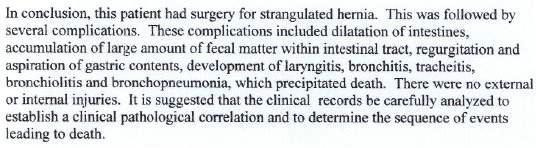
All of a sudden, my mom remembers the doctor explaining to her that when he did the surgery, he was supposed to put in a mesh over the area to prevent a hernia from occurring in the future. Still, he decided that it was not the best thing to do, so he would have to open my dad up for surgery in a month. After hearing that I wondered what else this doctor missed or didn’t do during the surgery.
These thoughts, coupled with my dad’s constant complaint of a burning chest and discomfort, were enough to make us start looking for attorneys. We spoke to several doctors and the Pathologist. They all said the same thing: Your father died because he aspirated fecal matter that was in his lungs, in his esophagus, and he developed all of the infections mentioned above as a direct result of bad surgery.
Basically, my father choked to death, and that Pulmonologist who supposedly saw him at noon the day he died, never even entered his room. There was no hospital record of this supposed visit, and even if he had seen my dad, he would have heard something wrong in my dad’s lungs.
The autopsy also revealed that my dad died earlier, not at 3:05 pm, as stated by the doctor.
I went back and heard the recordings and looked at pictures that I had taken of my dad’s room and his bedside chart, and guess what I found? The chart had no notes for that day regarding any doctor visits and nurse visits. The room also had a board where the charge nurse would write her name every day and the date along with the other on-call nurse. When I looked through the dozens of pages of hospital records I saw that no one visited my dad the day he died after his morning vitals check.
In addition to this, the board I photographed in my dad’s room on Monday, April 14th, still had Sunday’s information on it.
My sister was told by one of the friendly nurses in secrecy that “they should never have done that to your dad” and “If I had been his charge nurse, this would not have happened.”
Now, I know that my dad was taken away because his time was up, and I have accepted that fact. But it still does not mean that I have to stay quiet and hear about hundreds of people dying each day while being treated in hospitals and clinics worldwide.
The biggest lesson I learned concerning my dads’ tragic death is “NEVER trust anything anyone says until you prove it right yourself.” That is as it relates to being hospitalized.
Although not all doctors are criminals and careless, those inhumane ones exist, so be mindful and question everything for your peace of mind. I must add that I trust blindly in God, but it is sad to see people deposit that same trust in others who may not have their best interests at heart.
People trust doctors in a way that they don’t even trust God.
And just one more bit of this story is that no local attorney wanted to take our case. Interestingly all of them said, “You have a case, but it’s not in our best interest to represent you?”
One attorney said that if it had been his father, he would pursue a case until the ends of the earth but that his firm could not take the case. We later found out that the three firms we had asked for help often represented the hospital in wrongful death cases. So they obviously weren’t going to help us with our case. Instead, they held on to everything until the statute of limitation expired so we were left without a chance of suing.
Taking someone’s life and ten preventing a family from seeking justice should be a criminal offense, but nothing could be proven. In the end, I was left with so much anger, hurt and pain, as were our two oldest children who were still little at the time and loved my dad so much.
My dad was my inspiration for creating my blogs, wellness classes, nature exploring, and learning about herbal medicine.
I still remember planting potatoes, carrots, and cabbage with him. I remember at nine years using a machete to chop down corn plants and make compost for healthy soil.
I remember how my dad worked day and night frantically helping those who were poor and had no voice. His work helped people in so many countries.
The biggest blessing after my dad died was seeing the thousands of emails that poured in from all over the world. People were in shock and thanked him for his life work.
It was also a humbling experience for me to see all the recognitions, plaques, and letters from dignitaries and influential world leaders that my dad had kept a secret from us, stashed in a big duffel bag in my garage.
His humility and lack of self-awareness was the key to his peaceful life. He cared more about the things of others than about making a name for himself. It’s a legacy I want to hold on to forever.
He will be missed forever, but I know I will see him again someday, and then we’ll sing together: “Don’t worry about a thing, cause every little thing gonna be alright” One of his favorite songs!
I love you, dad!


 Chemical Free Gal
Leave a comment